Every business moving money across more than one party eventually hits the same wall. For a fast-growing platform it shows up as a spreadsheet the finance team maintains to track what is owed to each merchant, agent, or vendor. For an enterprise already running at scale it shows up differently: multiple banking partnerships stitched together, reconciliation that runs at month end, and no single view across the entire operation.
In both cases the signal is the same: the infrastructure is not keeping pace with the operation.
Why standard payment tools are not enough
A bank account holds a balance. A payment tool moves money from one place to another. Neither manages money across a platform's entire ecosystem.
When a marketplace settles merchants, a portion of each transaction belongs to the merchant, a portion to the platform, and sometimes a portion is held pending a condition. When an agritech platform disburses credit to farmers, it needs to ensure those funds are only spent on agricultural inputs. When a healthcare platform processes a refund, the balance needs to sit somewhere accessible to the patient without being immediately pushed to a bank account.
None of this can be handled by standard payment tools. Platforms end up building manual processes on top, reconciling after the fact, and catching errors late. At low volume this is an inconvenience. At scale it becomes the hardest operational problem in the business.
How Neem's multi-party ledger system works
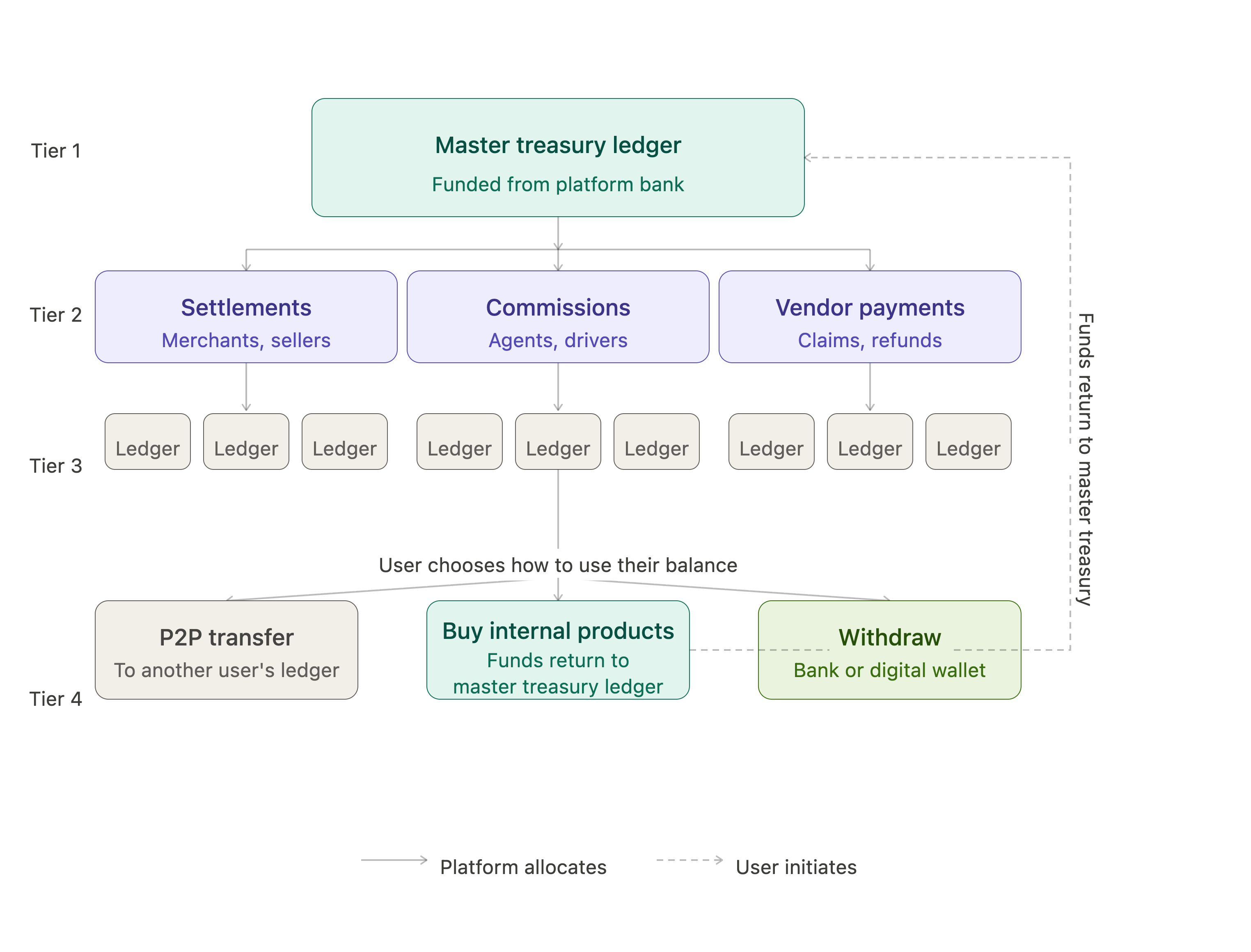
The infrastructure runs in tiers. At the top sits the platform's master ledger, funded from the business's bank whenever it is ready to disburse. Beneath that sit category sub-ledgers, one for each user type. Beneath those sit individual ledgers, one per user, each carrying a unique ID and the platform's own branding.
The platform defines the rules at setup: what gets credited to each category, when funds release, and where money can be spent. The individual ledger is the constant. If a user changes their bank account, they update their own withdrawal preference. It does not touch the platform's disbursement process at all.
Users do not need to provide bank details in advance. They receive notification that their balance is available and withdraw on their own schedule to any bank account or digital wallet.
Neem's multi-party ledger system gives every user the following within the platform's own infrastructure:
Their own structured balance with a unique ledger ID carrying the platform's branding
Real-time visibility into credits, debits, and transaction history
The ability to withdraw to any bank account or digital wallet at any time
Peer transfers to other users within the same ecosystem
In-platform spending on services the platform integrates
MPIN protection on all balance access
The platform gets a single business dashboard with a complete audit trail of every transaction across every user, acting as the single source of truth for the entire operation. The platform retains full control: what gets credited, when funds release, where money can be spent, and whether any conditions must be met before a payout triggers.
Because every fund movement runs through Neem's infrastructure, the platform also gains a data layer that was not accessible before. Operators can see exactly where users are transferring money, how funds flow across the network, and which patterns emerge over time. That visibility becomes the foundation for new financial products and use cases built on top of the infrastructure.
How the ledger system gets deployed
Platforms can deploy Neem's ledger system in two ways depending on how they want to present it to their users.
The first is through a fully branded app, built and deployed by Neem with no engineering effort required from the platform. The app carries the platform's name, logo, and identity. Users view their balance, track transaction history, transfer to any bank or wallet, send funds to other users within the ecosystem, or spend on services within the platform. The Neem business dashboard gives the platform complete visibility and control over every transaction across every user.
The second is full API integration, where the ledger infrastructure embeds directly into the platform's existing systems. Users never leave the platform's own environment. The API path enables complete automation of the fund flow: collections, balance management, settlements, and reconciliation all run programmatically without manual intervention. This is the deeper integration for platforms that already have their own interface and want the ledger running beneath it invisibly.
Where this infrastructure gets deployed
The multi-party ledger system is not built for one industry. It is built for any business that moves money across more than one party.
In logistics and courier, platforms use it to settle merchant payments the moment a delivery is confirmed, without managing individual bank account details across a network of hundreds or thousands of merchants.
In insurance, the infrastructure sits between a company's treasury and its outbound obligations, handling claim payouts to policyholders, commissions to agents, and payments to a vendor network, all from a single master ledger with full visibility at every tier.
In fleet and ride-hailing, platforms use it to settle driver commissions and bonuses in bulk, giving drivers real-time visibility into their earnings and the ability to withdraw or spend within the ecosystem on their own terms.
In distribution and trade, Neem connects brands, distributors, and retailers on one ledger network. Each party has their own ledger. Retailers top up and pay distributors instantly via ledger-to-ledger transfers. Distributors settle back to the brand the same way. Every movement is tracked in real time, reconciliation is automatic.
In healthcare, platforms use it to hold patient refunds in accessible balances within the app, so patients apply credit to future consultations without the platform processing a separate bank transfer for each one.
In agritech, platforms use it to disburse credit or subsidies to farmers with spending controls built in, ensuring funds flow only to approved agricultural inputs rather than being withdrawn as general cash.
In retail and marketplaces, platforms use it for seller settlements, ensuring every seller receives their portion of each transaction accurately and automatically, without a finance team managing disbursements manually.
The infrastructure also acts as a connection layer between separate platforms that already run on Neem. When two businesses operate within the Neem ecosystem, a new node can be deployed on an existing ledger to settle funds between them without either party building a separate integration. One platform collects, the other receives, and reconciliation is automatic on both sides.
The common thread across every vertical is the same: one operation, many participants, one infrastructure layer managing how money moves between all of them.
Platforms that already deployed Neem's ledger infrastructure
Pakistan's leading platforms across logistics, healthcare, agritech, and distribution are already live on Neem's multi-party ledger system.
Leopards Courier runs merchant settlements and withdrawals across its entire merchant network through Neem's ledger system. Payments settle directly into each merchant's dedicated ledger, and merchants withdraw to any bank account or digital wallet on their own schedule.
Sehat Kahani, Pakistan's largest digital healthcare platform, uses individual patient ledgers for consultation refunds. When a consultation is cancelled or rescheduled, the refunded amount is credited to the patient's balance within the app. Patients use that balance for future consultations or withdraw to their bank account without leaving the platform.
Indus Motor Company needed a way to collect payments on its platform and settle those funds directly with Leopards on its behalf. Because Leopards already ran on Neem's ledger system, Neem deployed a new node on the existing Leopards ledger. IMC now collects through Neem's payment gateway and settlements flow automatically to Leopards within the same infrastructure. Both parties get full reconciliation. Leopards gains an additional use case on its existing ledger. The model is replicable: any business that sells through Leopards as a distributor can be added as a node on the same system.
LAAM, Pakistan's largest fashion marketplace, goes live on Neem's ledger infrastructure to run settlements across its seller network. Every seller receives their portion of each transaction automatically, with full visibility into their balance and the ability to withdraw to any bank account or wallet on their own terms.
BaKhabar Kissan, Pakistan's largest agritech platform, disburses loans and subsidies to farmers through individual farmer ledgers. Spending is restricted to agricultural inputs on the BKK platform or from registered merchants via QR scan. The infrastructure enforces where the money goes.
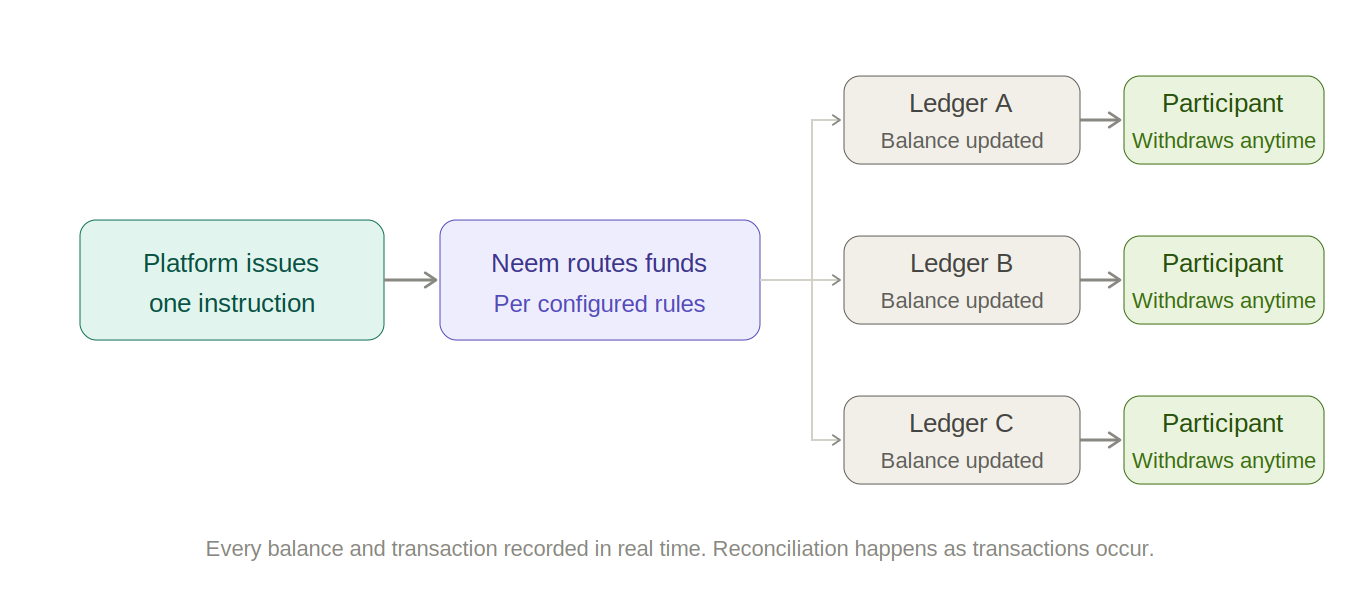
Dakia Courier runs merchant and driver settlements across its network through Neem's ledger infrastructure. One bulk instruction. Every user settled simultaneously. Reconciliation automatic.
Vizpro integrated Neem's ledger system directly via API into their existing platform, where brands, distributors, and retailers each operate a dedicated ledger. Retailers top up their balance using Raast or a bank account transfer, pay distributors by transferring funds between ledgers at no cost, and distributors settle back to the brand's bank account through the same infrastructure. Three distinct parties, three ledgers, one infrastructure layer managing all the money movement between them. No manual reconciliation. No separate payment arrangements between parties.
Flaship goes live on Neem's ledger infrastructure for merchant settlements. Merchants receive payments directly into their own ledger, with automatic reconciliation and real-time visibility into every transaction.
Three signals your platform needs this
The first is when the finance team maintains a separate tracker to know what the platform owes each participant. When the system of record is a spreadsheet rather than the platform itself, the infrastructure has fallen behind.
The second is when reconciliation takes days. Transactions have cleared but matching them to participants requires manual review, and every discrepancy takes time to resolve.
The third is when users ask for visibility into their own balance and the platform cannot provide it without building a reporting layer on top of a system that was never designed for it.
Any one of these signals means the infrastructure is not keeping pace with the operation.
One infrastructure layer, not a collection of tools
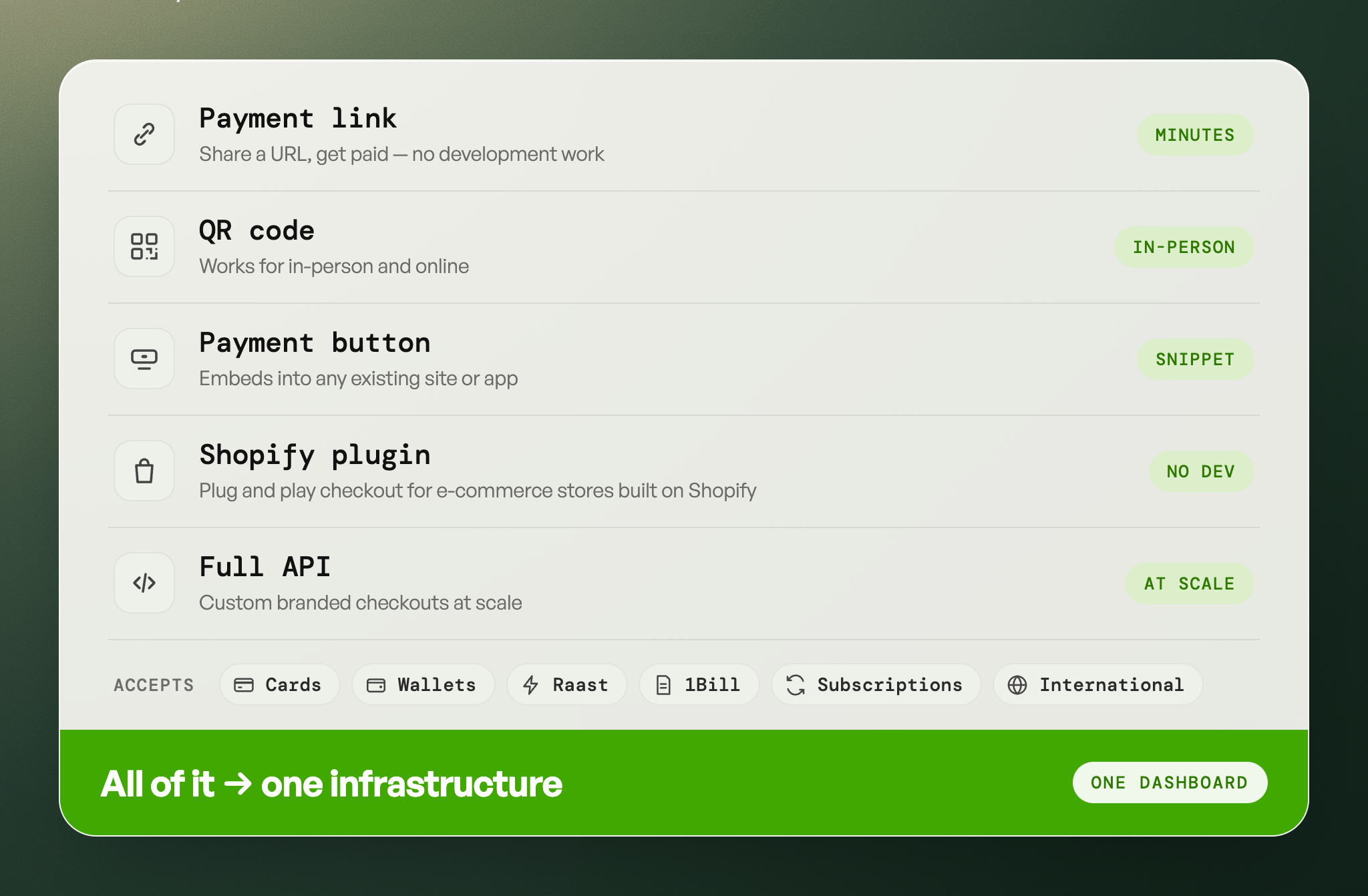
The ledger system does not sit alongside a platform's existing banking setup. It sits as a layer on top of it, bringing collections, disbursements, balance management, settlements, and reconciliation into a single infrastructure without replacing the banking relationships already in place. The platform has one dashboard with a complete audit trail of every transaction across every user. Users have their own balance, updated in real time.
This is the distinction between running a process and running a system.
If your platform moves money across more than one party, Neem's infrastructure is built for the operation you are running now and the scale you are building toward. Get in touch at neem.io/partner-with-neem.




.png)


